Showing posts with label Korean. Show all posts

Saturday, August 29, 2015

Korean Spicy Pork BBQ (Jeyuk Bokkeum / Dweji Bulgogi)

Another item that turned up at our family BBQ. We bought butterhead and lettuce vege and had the meat eaten in wrap paired with garlic and seasoned seaweeds. 

It was Mum and Dad's first experience eating wraps and gave thumbs' up. Tiring prepping the food but definitely worth it when family and people who appreciates your food show you that gratifying good and yummy sign, plus a thank you so much for the food!!! It is all these that push one on to make more yummy dishes.


Korean Spicy Pork BBQ (Jeyuk Bokkeum / Dweji Bulgogi)
Recipe by Korean Bapsang

2 pounds thinly sliced pork shoulder (900g)
1 small onion thinly sliced
3 scallions cut into 2-inch pieces
Marinade:
6 tablespoons Korean chili pepper paste (gochujang)
1 tablespoon Korean chili pepper flakes (gochugaru) (I left this out)
3 tablespoons soy sauce
3 tablespoons rice wine (or mirin)
2 tablespoons sugar (or brown sugar)
1 tablespoon corn syrup (or honey)
2 tablespoons sesame oil
2 tablespoons minced garlic
1 tablespoon grated ginger
1/2 small apple grated (about 4 tablespoons) – optional (I left out the grated apple)


Mix all marinade ingredients well. Combine the meat, onion, and scallions with the marinade and mix well.

Marinate for about an hour.
(I left it in the freezer to do its job for 2 days, brought it down the night before BBQ to let it defrost.) Grill over charcoal or pan fry in a skillet over medium high heat until slightly caramelized. (Preheat and lightly oil with sesame oil before adding the meat. If pan frying, do not crowd the skillet. Adjust the heat as necessary.)

Friday, June 12, 2015

Beef Bulgogi


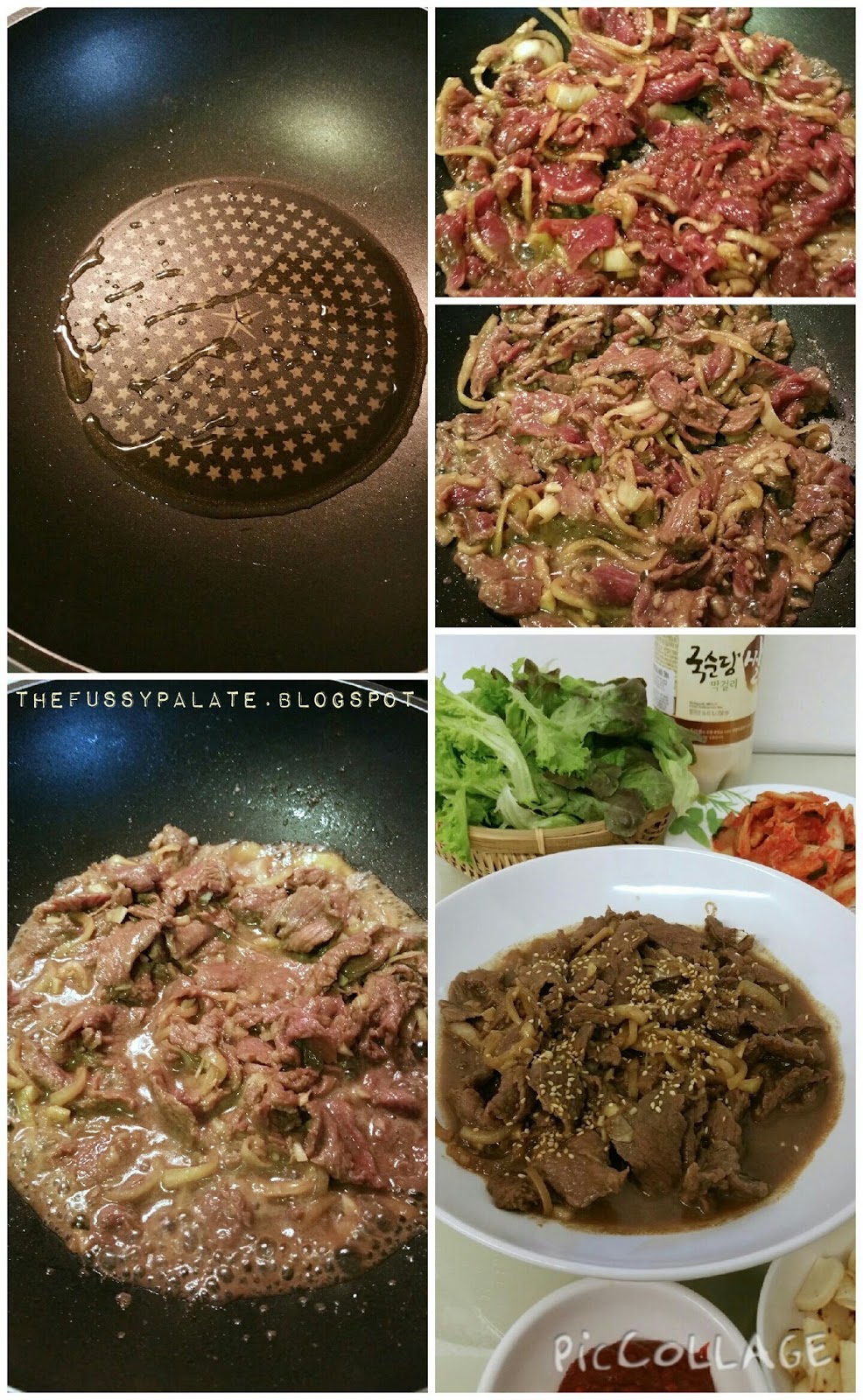
Another Korean meal for dinner, upon Hubby's request. Since I had a bottle of beef bulgogi sauce bought from Lotte Mart in Seoul from the last trip, I aceded to the Hubby's request.

Brought out the Makgeolli (Korean Rice Wine) and had it with the meat. Not quite a meat lover, but I thoroughly enjoyed that meal of meat and wraps, and drinks! Still can salivate at the thought of it. I wanna cook this soon again!


It would have been abit more work if I made the meat marinate from scratch for I would need pear puree, onion puree and many more ingredients for it. As usual, I took a short cut and used store bought beef bulgogi sauce! Easy peasy. No more lazy shortcuts when I finish up that little bottle.

We had bought more beef than we intended to cook and I marinated it all anyway, just store it in 2 tupperwares. You can freeze 1 portion of the marinated meat, and just bring out to thaw before cooking it. The other portion I merely refrigerated it and let the marinate does its job for like 20 hours before cooking it the next day.  Yummy!

And so with the remaining portion of frozen marinated beef, I cooked them and had it with rice. It was good!

Wrap style or with rice? Your choice :)

Beef bulgogi with a sunny side up.
*
*
*
I am hungry as I write.
:P


Beef Bulgogi
Serves 2 to 3


370g fresh chuck tender beef (you can use sirloin beef too)
6 to 7 tbsp store bought beef bulgogi marinade
2 garlic, minced
1 tsp sesame oil
1 yellow onion (or 2 if you like onions), de-skin, halved and cut into 4 pcs for each half
dashes of ground black pepper
1/2 tsp garlic powder (optional but I just wanted to add it hehe)

Garnishing
White sesame

1. Wash beef and dap dry with a kitchen towel. You may choose to slice it when frozen so that you get thin pcs from easier slicing, or be like me just slice it after drying and at room temp. If you are letting the meat be marinated in fridge overnight for more than 6 hours, not slicing it too thinly is okay. Longer hours of marinating tenderizes the meat.
2. Place sliced beef into a container. Add in all sauce, and ingredients and mix well to coat meat evenly. Cover and place in fridge to marinate for at least 2 hours, or better still, overnight.


3. When ready to cook meat, heat 2 tbsp of oil in frying pan, place in marinated meat, break up meat and stir fry till cooked, which takes less than 5 min. Beef slices get cooked fast.


4. Serve immediately with some white sesame sprinkled over. Eat with lettuce and ssamjang plus other sides that you like or enjoy it with plain rice.

Monday, May 11, 2015

Kimchi Fried Rice 韩式泡菜炒饭 (Kimchi Bokkeumbap) 김치볶음밥


I can't wait for my next trip back to Korea again, for their food! Not that I am flying again anytime soon, that is just me daydreaming. Hehe!

Everything Korean is kinda part of my lifestyle now. From food to variety shows to dramas, songs, facial products, make up and so many more. It is why more Korean food is popping up here in this space.

We had just one serving of kimchi rice in Seoul and that left me craving for more I just had to cook them at home.  Might not be the authentic Kimchi Fried Rice but at least it could fill a void in me. Hey at least the kimchi was from Lotte mart okay!

Do you love kimchi like I do?

Okay, I tried to take a shortcut here with a heat-up-and-ready-to-consume soondubu jjigae (spicy tofu stew) which I also lugged back with me from Korea. I just threw in more ingredients of my own and voila, a meal of rice and soup.


Aren't jotting down how I cooked the soup because it was just cutting up side ingredients, emptying soup contents into my Korean ddukbaegi, an earthernware that is traditionally used to cook guk (soup) and jjigae (stew). It was worth the while buying this ddukbaegi back here. I love how it keeps my soup and stew hot till we finish our meal. Nice!


Hubby said he thought he was back in Korea when he sipped one spoonful of the stew.

Now, on to my kimchi rice cooking experience.

Kimchi Fried Rice (Kimchi Bokkeumbap) 김치볶음밥
175g Kimchi
2 cups cooked rice
2 tbsp butter
3 tbsp Kimchi juice
2 eggs
1 tsp salt
½ tsp black pepper

I also used:
1 garlic, minced
1 spring  onion (green onion) – sliced side, thinly (leave sliced white parts for frying, and green part for garnishing)
Drizzle some sesame oil over once Kimchi rice is fried and done


1.        Make rice
Cook rice if you don’t have any. Use Korean rice, also known as short grain rice, sticky rice or Japanese rice. See cooking white rice in a pot andcooking white rice in a rice cooker. For fried rice, make the rice a little drier than usual by adding a little less water. This prevents your Kimchi Fried Rice from becoming too soggy. White rice is usually used for Kimchi Fried Rice, but multigrain or brown rice is okay too. 

2.        Chop kimchi
Chop kimchi into ¼” pieces (about 1 cm) to yield 1½ cup of chopped kimchi (about ⅛ of a whole nappa cabbage kimchi). It’s ideal to use over-fermented (sour) kimchi. You can also add meat or vegetables you like (see tips above). Chop them into the same size as kimchi. 

3.         Butter
In a large pan or wok melt 2 tablespoons of butter on medium heat. (You can add one more spoon if you love butter.) If you are not using butter, you can use vegetable oil but adding some sort of meat to the dish is recommended to enhance the flavor. (Add in minced garlic and white part of spring onion / green onion and fry for awhile)


4.        Saute kimchi
Add chopped kimchi to pan and saute for 5-10 min on medium heat or until kimchi is cooked completely. Add 3 tablespoons of kimchi juice (optional) while cooking. If kimchi starts to stick to the bottom but not cooked through yet, add a little bit of water or more kimchi juice. You can add more kimchi juice if you like it spicy. If you don’t have kimchi juice, you can also add some gochugaru for more spiciness and red color. 

5.        Add rice
Reduce heat to low. Add 2 cups of cooked rice and mix thoroughly. If you are using cold leftover rice, make sure you mix it until there are no cold lumps of rice and all the rice is warmed up. Let it sit on low heat for about 5 min. If you like it crispy on the bottom, you can spread the fried rice thinly over the pan and cook on low heat until the crispy bottoms if formed. 

6.        Season
Taste and season with salt only if necessary. The amount of salt depends on the saltiness of kimchi and how much kimchi juice is used. Add a pinch of black pepper. 

7.        Fry eggs (optional)
In a pan, add a little bit of vegetable oil and fry eggs on medium heat. Season with salt and pepper. You can cook one egg for each serving. Sunny side up is great for presentation but you can cook to your preference.
8.        Serve
Serve Kimchi Fried Rice on a plate. Top it with a fried egg. Enjoy! 


Dig in!

Thursday, April 23, 2015

Spicy Pork Bulgogi 韩式辣炒猪肉 돼지 불고기


As you can see, I am already back from Korea for quite some weeks, but am still (very!) much bitten by the Korean food bug. I have always enjoyed eating Korean food, and this trip brought my love for Korean food to a next level. I just had to cook it at home. Hubby gave compliments during the meal and commented that "I thought I am back in Korea leh!" 

My first time at preparing and cooking Korean style marinated meat. A wonderful experience and I am looking forward to cooking beef bulgogi, chicken bulgogi.... anything Korean food soon! 

With the few stuff I bought from our grocery shopping at Seoul Lotte Mart, Hubby can expect more Korean food. I have pre-empt him on that and he was game for it.

I love my wonderful and supportive hubby lor! :P

Thank you all for dropping by.

Kamsahamnida. 


Spicy Pork Bulgogi  돼지 불고기
Recipe and notes from Crazy Korean Cooking


9 oz Sliced Pork (Belly or Neck)  (thinly sliced) – I used about 250g of twee bak because I wanted leaner meat
3 tbsp Hot Pepper Paste (Gochujang) (spiciness and saltiness may vary depending on the brand)
2¼ tsp Sugar
1 tsp Soy Sauce for Soup (Gukganjang)   (or regular soy sauce)
½ Onion (Medium)
1½ Green Onion (Spring onion as we call it)
1 tsp Garlic (minced)
1 tsp Ginger (minced) – I did not have ginger on hand, hence I left it out
A pinch of Black pepper
1 tsp Sesame oil
1 tbsp Cheongju, Korean Rice Wine  (I used Japanese Sake cooking wine)
½ tsp Sesame Seeds  (optional)
2 Green Chili Pepper  (optional) – I did not use this
1½ tsp Vegetable Oil
1 tsp Gochugaru, Red Chili Flakes 고추가루(optional, add to make it super spicy) – I did not use this


Optional Ingredients and Substitutions 
Pork: You can use chicken or beef instead. Make sure to thinly slice the meat for the best result.
Sesame seeds: can be omitted.
Green chili peppers: Green chili peppers add a very nice spicy kick. Red chili peppers are ok too but they are usually less spicy. You can omit chili peppers if you want a mild version.
Sugar: can be replaced with honey.
Good to Know 
The amount of gochujang (red chili paste) and sugar can vary depending on your preference. If you use less gochujang, you may want to increase the amount of soy sauce or use salt to season.
For medium spiciness, reduce the amount of red chili paste to 4 tablespoons (for default serving size - 4 servings).
To make it extra spicy, add 1 to 3 teaspoons of gochugaru (red chili flakes) (for default serving size - 4 servings)


1.        Cut pork
If the pork is not sliced, slice as thinly (⅛”) as possible. If pork is slightly frozen, it’s easier to cut into thin slices. If the slices are too big, cut into roughly 3” squares. They don’t have to be square shaped as long as the area is about that size.

2.        Prepare vegetables
Peel and slice a medium onion (or ½ large onion). Wash and cut 3 green onions into 2 inches. Mince garlic and ginger. Wash and Slice 4 green chili peppers (optional).

3.        Make marinade
Mix 6 tablespoons of gochujang (red chili paste), 1½ tablespoons of sugar, 2 teaspoons of minced garlic, 2 teaspoons of minced ginger, chopped green onions, ¼ teaspoon of black pepper, 2 teaspoons of sesame oil, sliced onions, chopped green chili peppers (optional), 1 teaspoon of sesame seeds (optional) and 2 tablespoons of cheongju (korean rice wine) (optional). *For medium spiciness, add 4 tablespoon of gochujang instead of 6. To make it extra spicy, add 1-3 teaspoons of gochugaru (red chili flakes) on top of gochujang (red chili paste).

4.        Marinate meat
Place the meat in a large bowl. Separate the meat slices so they are not stuck together. Add the marinade. Using your hand (use plastic gloves to protect your hand from hot paste), mix everything thoroughly and work in the marinade for 3-5 minutes. Cover and refrigerate for at least an hour (6 hours is ideal). If your meat is thicker than ⅛”, marinate overnight.


5.        Cook meat
Coat a frying pan with vegetable oil. Cook the marinated meat on high heat for 10-15 min or until the meat is fully cooked and the surface is nicely browned. *If the meat is thick, you must cook on medium heat so the meat is cooked through. Then, cook on high heat to brown the surface.


6.        Serve
Serve on a plate and sprinkle sesame seeds to garnish (optional). You can enjoy it with a bowl of rice or make “ssam” (wrapping a piece of meat with a dab of ssamjang (lettuce wrap sauce) in leafy lettuce).

I made some ssamjang sauce by mixing 1 tsp gochujang with 2 tsp doenjang (fermented soy bean paste). 
I personally feel that spicy pork bulgogi does not go too well with ssamjang as ssamjang tends to cover the spicy bulgogi taste with its strong bean sauce smell and taste.
Ssamjang goes better with beef bulgogi wraps :)

Tuesday, January 20, 2015

Korean Dried Scallop Porridge


Sometimes after a few days of good food or greasy sinful food, I crave for simple plain porridge to get by the remaining week. I will either cook plain white porridge and settle the meal with some preserved olive vege and some pork floss or cook some congee.

As I was flipping through one of my recipe book lazy week, I saw this one recipe by Jin Yin Ji's Korean Kitchen Book. It is a simple dried scallop porridge which I cooked, and we like it.  I thought it was good and easy enough for toddlers too.

Haven been craving for this and will be cooking it again soon!

Dried Scallop Porridge
Recipe by Jin Yin Ji's Korean Kitchen Book

1 cup rice
1 1/2 anchovy / chicken stock
3 pcs dried scallop
150g lean pork
2 pcs of garlic
3 shallots
1 tbso oil


Seasonings
a dash of pepper
sone soy sauce
some salt

1. Rinse and soak dried scallops in clear water till they become soft.  Tear the scallops into shreds. Drain well and set aside. Keep the water used to soak the dried scallops.  (I rinsed the scallops and soaked them overnight in the fridge, covered.)


I used 3 big Hokkaido dried scallops and several small ones because I want more bites of them in my porridge 😁


2. Peel and finely chop shallots and garlic separately.
3. Chop the lean pork up to minced meat.  (I used mixed meat. Saves the effort of mincing them on my own.)
4. Rinse rice grains and soak them in clear water for about 20 minutes.
5. Heat oil in a wok and fry shallots and garlic till fragrant.


6. Add in shredded scallops and minced pork, and fry till cooked.
7. Add in stock and the water used to soak dried scallops. Simmer over low hear for about 40 minutes.
8. Add in rice grains and continue to simmer till porridge is formed.


9. Add in seasonings to taste before serving.


Monday, December 15, 2014

Danpatjuk - Korean Sweet Red Bean Porridge

Time flies and it is gonna be Dongzhi Festival (or Winter Solstice Festival), the time of making and eating tangyuan (glutinous rice balls) again.

Dongzhi is an important festival widely celebrated by Chinese and it is the time where families gather to eat tangyuan. Do you know that in Chinese culture, Dongzhi is also the day where everyone becomes one year older?  Sad for me because I am gonna be another year older :P

Interestingly, Koreans also celebrate this Chinese festival by eating tangyuan, of which these glutinous rice balls are cooked in strained red bean soup.  In the olden days, Korean placed bowls of these sweet red bean porridge (danpatjuk) around their houses. Some red bean porridge were even applied to door of the houses, of which was done to chase away any evil spirits. After the ritual done, they will enjoy the danpatjuk.

I cooked a pot and brought some back to Mum's place to share with my family

I remember how I used to help my grandma and mother roll out the dough into small balls. I love eating them too. Since I have always ate tangyuans cooked in sweet ginger soup, I decided to try making the Korean Sweet Red Bean Porridge this time.

I gotta say I enjoyed the cooking process as well as eating it. I love how the sweet red bean compensate for the bland taste of the glutinous rice balls. You may eat this as a dessert or as a meal because it can be quite filling to the tummy.


Danpatjuk - Korean Sweet Red Bean Porridge
(Recipe adapted from Crazy Korean Cooking
Serves 3 to 4

For Pre-cooking red beans
240g red beans
480ml water - to be discarded after

For the Soup
1680ml water (only some may be used after boiling beans)
60g sugar
2g salt
1g Cinnamon powder (optional)

For sweet rice balls
240g sweet rice (Glutinous rice powder)
90ml water (boiling hot)
1g salt
5g pine nuts (optional garnish) - I did not add them


1. Wash red beans
Wash 1 cup of red beans 2-3 times. Do not rub them too hard or too long. Drain water in a strainer.

2. Precook red beans
Place washed red beans in a pot and pour 2 cups of water. Bring it to boil then keep boiling on high heat for 5 minutes or until the water turns red.

3. Drain water
Drain water out in a strainer. Throw away the water and keep the red beans.


4. Boil red beans
Place precooked red beans in a pot and add 7 cups of water. Boil on high heat. When the water starts to boil, adjust the heat to low heat and keep boiling uncovered for more than 60 minutes or until the red beans become soft and mushy.


5. Make dough
While red beans are being cooked, make sweet rice balls. Mix ¼ teaspoon of salt into 6 tablespoons of boiling water. Mix 1 cup of sweet rice powder and the salt water. Start kneading with a spoon for a couple of minutes to avoid burning your hands.

6. Knead dough
Then, knead the dough by hand for about 5 minutes or until it becomes soft. It may seem like there is not enough water but the dough only comes together when you knead by hand diligently for a while. Add a bit more water only if the dough doesn’t come together after kneading for more than 5 min.

7. Make balls
Make the dough into bite-sized balls (about ¾” or 2 cm in diameter).

I think my right arm got slightly toned from getting the red bean through the strainer :P

8. Strain red beans
Pour the red beans with the boiled water through a strainer (or a sieve) into a bowl. Remember to keep the water.

9. Grind red beans (Optional) - I skipped this step and put the cooked red beans through the strainer)
Grind red beans with an electric grinder. If you don’t have an electric grinder, you can skip to the next step. It will just take longer and may be strenuous on your hand.

10. Mash red beans
Place the strainer with the ground red beans over a bowl. Then, mash them with a spatula so the soft part (red bean paste) of the red bean is going through the strainer into the bowl and only the husks (skins) are left in the strainer.

11. Grind red beans
Scrape off any red bean paste stuck at the bottoms of the strainer. Throw away the husks and keep the red bean paste (the water and the mashed red beans). This will yield about 3 cups of red bean paste.


12. Boil red beans paste
Put the red bean paste from the previous step in a pot and add the same amount of the water the red beans were boiled in. If 3 cups of bean paste were yielded, add 3 cups of the red bean boiled water. (red bean paste:red bean boiled water=1:1) Mix them well and boil on medium heat. When it starts to boil, add the sweet rice balls and boil for another 5-10 minutes or until the balls are fully cooked (they will float to the surface). Stir frequently. Be careful as the soup may splash when boiling! If the soup becomes too thick, add more water.

13. Finish
Turn off the heat. Add ½ teaspoon of salt and 4-8 tablespoons of sugar (more or less depending on your taste and whether you are serving it as a meal or dessert). The amounts are for 3 cups of red bean paste. If you have less, you will have to reduce the amount of salt and sugar. Taste and add gradually. Sprinkle ¼ teaspoon of cinnamon powder (optional).


14. Serve
Serve in a bowl and top with a few pine nuts or crushed walnuts (optional). Enjoy!


How to store Sweet Red Bean Porridge
Both cooked red beans and sweet rice balls are easily spoiled.  Refrigerate as soon as it cools down if not eaten right away.
It may keep in the fridge for a couple of days.  If you want to store it longer, seal tightly and freeze it.  Then slowly thaw in the fridge or in the microwave on defrost mode.

Saturday, December 13, 2014

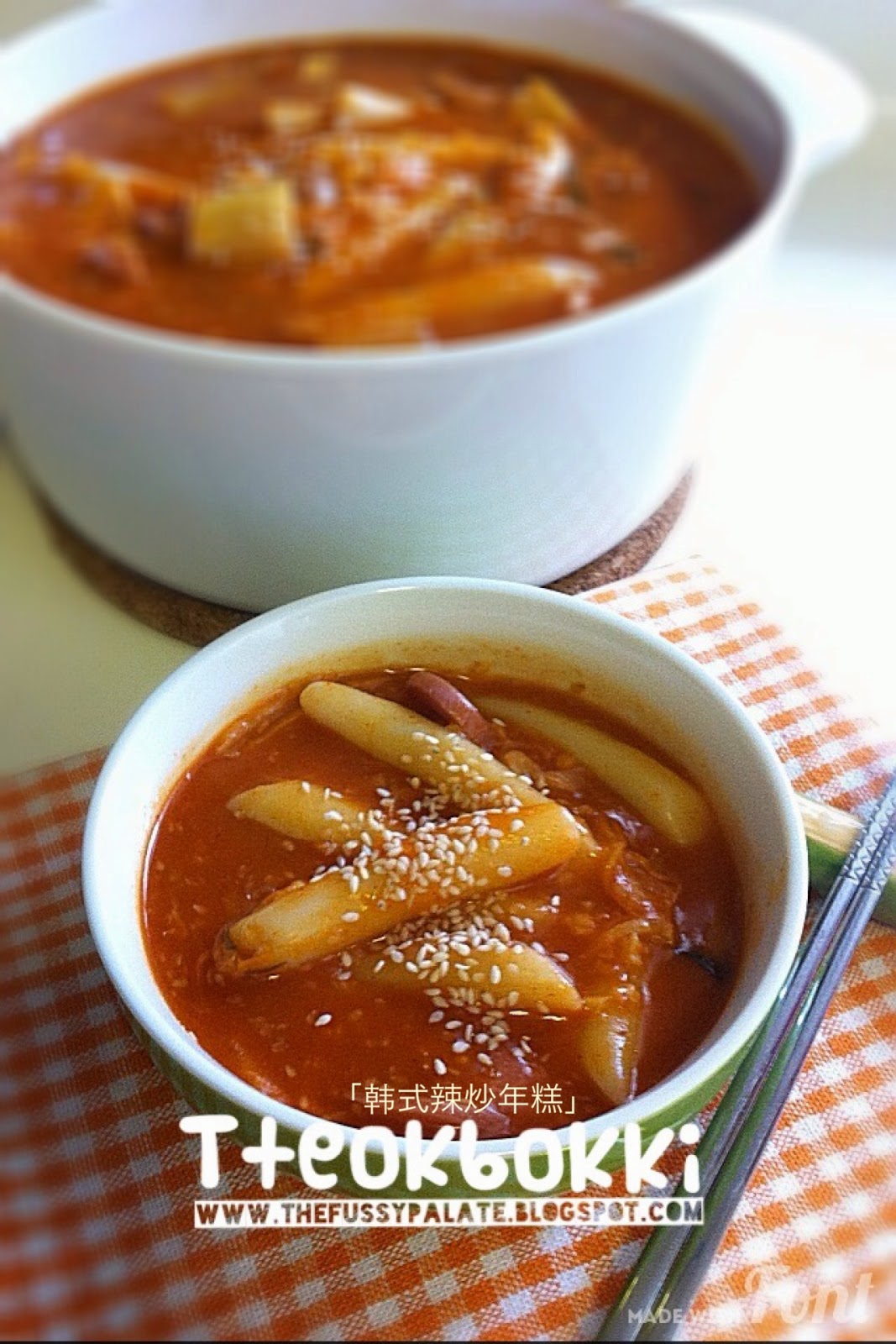
Tteokbokki (Korean Spicy Stir-fried Rice Cake)


Have you tried tteobokki, Korean Spicy stir-fried rice cake before? I love this Korean dish which is commonly found along the streets of Korea. I love it for its spicy chewy tasting rice cake. I love the bite of the rice cake.  I like that it can fill me up easily, and that leftovers can be kept overnight, only to be reheated the next day and paired with instant ramen.

Authentic tteokbokki does not have the addition of chicken franks and chinese fishcakes but i added them anyway because this was gonna be our one-pot dish for a Saturday evening. I could not get Korean fishcakes, hence I used the chinese one. Oh... I miss tteokbokki now as I blog away! I love Korean food. Okay, Korean anything, anything Korean I all like :P


Tteokbokki (Korean Spicy Stir-fried Rice Cake)
(Serves 3 to 4)

1 packet of rice cake (I bought Singlong brand, 500g rice cake)
300g bokchoy or cabbage (wash and cut into 1 inch size)
1 sheet of Korean fishcake (I used 1 whole pc of the chinese kind)
5 pcs spring onion (3 to cut into 1-inch long, 2 to cut into small bits for garnishing)
1 chicken frank (sliced thinly) - optional
2 to 3 tbsp Gochujang, Korean red chilli pepper paste
About 1.2l anchovy stock (1 handful of dried anchovies + 1.3l water)
6 pc garlic, minced
1 tbsp light soy sauce
2 tbsp sugar
2 to 3 tsp sesame seeds
1 tsp sesame oil

1. Remove head and guts of dried anchovies and rinse with water twice. Drain and put anchovies into stock bag or straight into small pot. Fill pot with 1.5l water and bring to a gentle boil, without lid on hight heat. Bring down heat to medium high and let boil for further 15 to 20min. Use a strainer to remove anchovies. Set aside.
2. This could be an extra step but I normally do this to remove excess oil and perhaps quicken the cooking of the rice cake at the later stage. In a separate pot of boiling water, blanch rice cakes for  about 1min, remove with sieve or strainer and leave in a pot of room temperature water.

3. Pour anchovy stock into a bigger cooking pan and turn on high heat and bring to a boil. Add in minced garlic and Korean red chilli pepper paste (gochujang) and stir well till  chilli paste dissolves. Add in sugar and light soy sauce and stir till sugar dissolves. You may taste the sauce to see if you would like to add in more chilli paste or add in more sugar to bring down the spiciness.

4. Add in blanched rice cakes, sliced chicken franks, fishcakes and spring onions, stir and mix well. Cover with lid and let boil for about 8min.

5. Stir in bokchoy or cabbage and stir well. Cover and let boil for further 5min or so till rice cakes have softened. Stir in sesame oil and sesame seeds. Serve!

An easy and simple to cook yummy Korean street food!

To reheat, add in a little water and bring to boil on low heat. Sprinkle with some sesame seeds and serve.

Wednesday, August 6, 2014

Korean Mochi Bread


I am really slow in the bake craze.  Where was I when these Korean mochi buns were so popular among bakers in the blogsphere???  Well, not sure if these buns are now well forgotten, I am still gonna bake it anyway. When the craving attacks come, no one and nothing can stop me, hehe!

Bought a pack of this bread premix when out for dinner with my sis and bro at Bedok Mall.  2 packs of premix in a box, and so I can bake them twice in different flavours!


These QQ babies are actually not your usual soft and fluffy buns. These babies have chewy bites to them, and I guess that's about it, unless you inject some 'life' into them by turning them into cheesy mochi buns, adding matcha, cocoa or any other ingredients that you can think of.  I like it most when these mochi buns are served soon when out of the oven while still warm, over a cup of coffee.  Yums!

Korean Mochi Buns
Recipe by Happy Home Baking

250g (1 packet) mochi bread flour mix
1 egg
70ml water (you may use milk if preferred)


1. Mix flour, egg and water in a mixing bowl. Gather to form a soft dough.
2. Divide dough into 8 to 10 equal portions. Shape into round balls.
3. Place doughs on baking tray lined with parchment paper. Cover with cling wrap or a damp cloth, leave to rest for about 15min.
4. Spray the doughs with some water.
5. Bake in preheated oven at 180degC for 30~35min or until golden brown.


Note: These rolls taste best on the day they are made.